Oval, D-shaped, round and square toilet seats: how they differ and how to tell which one you need

You picked a seat that looked right, and you fitted it carefully, following the instructions. But when you sit down, it shifts to one side. Or it sticks out at the back, or falls short at the front and leaves the rim of the bowl showing. You adjust the hinges, tighten the screws, and nothing changes.
It isn’t a faulty seat or a mistake during fitting. It simply doesn’t match your toilet. It’s one of the most common errors when refreshing a bathroom, and there’s a reason for it: many toilet shapes look so alike that they are hard to tell apart at a glance. Current models from different manufacturers are very similar to one another, and among older ones the variety is greater still.
Choosing well doesn’t depend on whether you like the seat, but on knowing what to look for. In this article we explain how to recognise the shape of your toilet and what measurements to take so you get it right first time.
The four most common toilet shapes
There are countless seat shapes on the market, as many as there are toilets. But most fall into four basic shapes. To work out which is yours, look at the bowl from above.
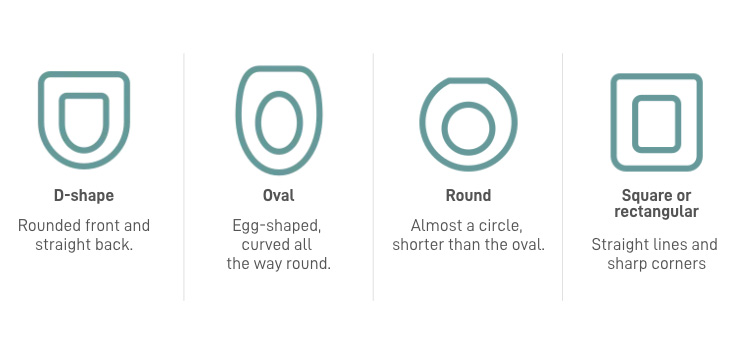
D-shaped
Seen from above, it has the shape of the letter D. The front is rounded and the back, the part next to the cistern, is straight. It’s a shape you’ll find above all in current mid-range and high-end toilets.
Oval
This is the most common, and probably the one you have if your toilet is a few years old. It resembles an egg: the front is rounded and the sides curve round to the back, with no straight sections. Not all oval seats measure the same, so even if you’re clear about the shape, it’s worth measuring.
Round
It looks like the oval, but it’s shorter and flatter, almost a circle. It tends to appear in compact toilets designed for small bathrooms.
D-shaped, oval or round toilet seats: how to tell them apart
These three are the ones most often confused, and understandably so: in passing, they look very alike. The difference usually comes down to two details.
The first is the back. On the D shape it’s straight, and the sides run straight down to it. On the oval and the round, the whole outline is curved.
The second detail separates these last two, and it’s the proportion. The oval is more elongated, with its egg shape. The round is shorter and almost as wide as it is long.
Square or rectangular
This is the easiest to identify because it doesn’t look like the other three. It has straight lines and sharp corners, and it’s the shape of many toilets with a contemporary design. As these shapes are more recent and less standardised, the seat has to match both at the corners and in the exact measurements.
Other shapes
Besides these four, there are toilets with unusual curves, uncommon lengths or designs specific to a particular brand. These are the hardest to identify and, often, the hardest to find on the market too.
What happens if you choose the wrong seat
Not being sure of the shape is a headache in itself. But getting it wrong has consequences that go beyond the purchase:
- Appearance. A seat that doesn’t follow the line of the bowl shows at a glance. It can spoil the look of a whole bathroom over a single part.
- Comfort. If the seat overhangs or falls short, it doesn’t rest properly on the rim. Sitting down feels uncomfortable and unstable.
- Durability. A seat that wobbles puts extra strain on the hinges and fixings every time it’s used. They work loose sooner and the seat lasts less.
- Hygiene. If the seat doesn’t cover the rim properly, exposed areas are left where dirt builds up.
- Fitting. In the worst case, it simply can’t be installed.
Getting it right: measure before you choose
Three figures are enough to avoid mistakes: the length from the back edge, next to the cistern, to the furthest forward point of the rim; the maximum width of the bowl; and the distance between the centres of the two fixing holes. With those measurements, the shape is no longer a guess.
And if the toilet is old or you don’t recognise the brand, that’s the starting point for identifying your model and finding the right seat, a process we explain step by step in this guide.
At ETOOS we manufacture the seat that fits your toilet
We start from a simple idea: one toilet, one seat. We manufacture seats using the brands’ own models from each era as the mould, and we hold more than 300 models, along with the capacity to create custom seats in specific shapes and styles.
If you’re looking for a universal, hard-wearing option, our Duroplast seats cover the most common shapes on the market. And if you need an exact fit for a particular model, we make it to measure in Resiwood, our own in-house wood.
Tell us which toilet you have and we’ll find the seat that matches it.