In a home bathroom, a lid that lowers on its own and without a bang is mostly a convenience. In a facility with hundreds of uses a day, that same soft close toilet seat becomes a technical decision: it affects spending on replacements, maintenance hours, and how the space is perceived. In the lines below we’ll look at when a toilet seat soft close system is worth choosing for a heavy-use bathroom and what real advantages it offers over a conventional seat, so you can decide whether to include it in your next installation.
When soft close stops being an extra
In a house, a self closing toilet seat is a question of comfort. In a hospital, a hotel, a care home, or a school, the same mechanism answers to requirements that usually appear in the specification: cutting noise, extending the product’s service life, and lowering the maintenance load. When a lid opens and closes hundreds of times a day, the repeated impact against the ceramic stops being a detail and becomes a cost variable. That is where a heavy duty toilet seat earns its place.
Durability and total cost of ownership
A soft closing toilet seat adds one more mechanism than a fixed hinge, so the point isn’t that it fails less on its own, but that it protects the rest of the assembly. By slowing the descent, it prevents the repeated slam that fatigues the seat, the ceramic, and the fixing, which means less play, fewer loose screws, and fewer full-seat replacements. For that advantage to hold up under heavy use, the hardware itself has to be up to the job: quality damping, with components sized for hundreds of cycles a day, is what separates a system that lasts from one that becomes the weak link. The higher upfront cost is offset three ways: a longer service life for the assembly that spaces out replacements, lighter maintenance, and the option, in removable systems, of replacing only the hardware without scrapping the whole seat, which ties in directly with the quick-release systems for toilet seats. This calculation makes particular sense in heavy-use installations, where every avoided replacement is multiplied by the number of washrooms.
Noise reduction in sensitive settings
There are installations where quiet is part of the service. In a hospital at night, in hotel rooms, or in a care home, the sharp bang of a lid is an avoidable source of noise that affects rest and the perception of quality. A quiet close toilet seat removes it entirely, without relying on the user to guide the lid down by hand. It’s an improvement that doesn’t show up on the spec sheet but translates into complaints that never arrive.
Safety and accessibility as a requirement
In spaces with children, older people, or users with reduced mobility, a lid that drops under its own weight is a finger-trapping risk. An anti slam toilet seat neutralizes that risk, which makes it especially suitable for school bathrooms, geriatric settings, and healthcare environments. Along the same line of design meant to gain independence in the bathroom, a slow close toilet seat is a natural complement, not a cosmetic add-on.
Soft close seats for commercial facilities
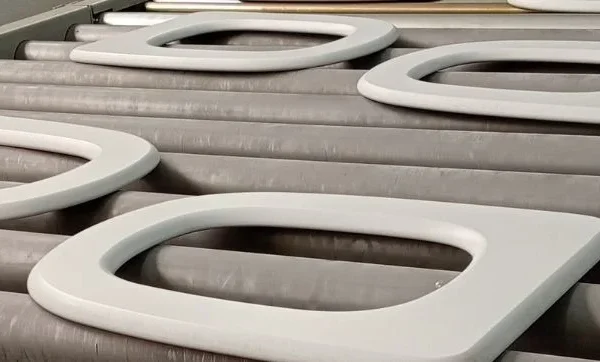
At ETOOS we build the soft close toilet lid into seats made in Duroplast and Resiwood, with stainless steel fittings sized for intensive use. That damping works alongside the range’s quick-release system, so a single commercial toilet seat closes without noise and comes off in seconds for a deep disinfection. If you manage or specify the bathrooms of a hospital, a campsite, a school, or any high-turnover facility, and you’re weighing up the best soft close toilet seat for the job, tell us about the project and we’ll help you define the seat and hardware combination that fits the specification best.